
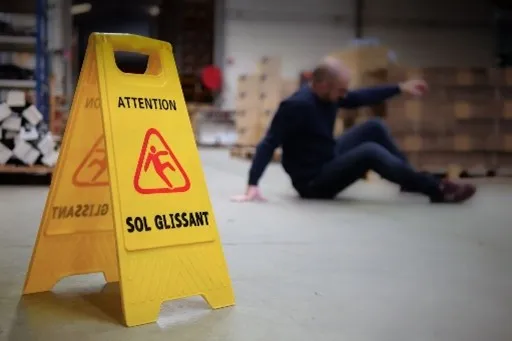
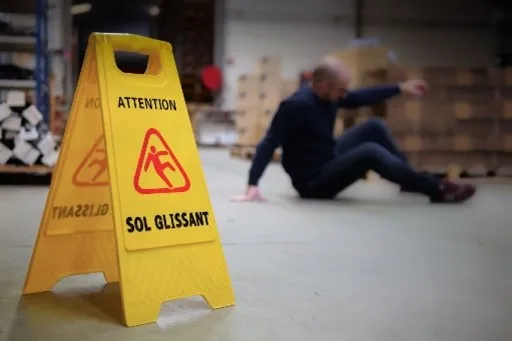
Saviez-vous qu’au cours de ces deux dernières années, les chutes de plain-pied (glissades, trébuchements, faux-pas et autres pertes d’équilibre sur une surface plane) représentent la 3ème cause principale d’accidents au CERN. Ces chutes surviennent aussi bien à l’intérieur qu’à l’extérieur des locaux. Avec une part de 12% de l’ensemble des accidents répertoriés, cette catégorie d’accidents représente au total 15% des causes d’absence au travail.
Sur quels aspects du travail pouvons-nous agir collectivement pour limiter ces accidents au quotidien?
Organisez-vous : Planifier au mieux votre agenda, vos interventions et vos projets afin de ne pas créer de situations d’urgence au sein desquelles, la précipitation peut amener à une chute.
Assurez-vous que l’éclairage de votre espace de travail soit adapté et les limites sonores soient respectées. En effet, un environnement bruyant augmente le stress et diminue l’attention au travail. En cas de doute, des mesures peuvent être effectuées, n’hésitez pas à contacter le SY Safety Office !
Dégagez les voies d’évacuation, les voies de passage et votre espace de travail. Évitez d’entreposer du matériel et ne laissez pas des câbles au sol, organisez votre rangement de manière à ce que le risque de trébuchement soit maitrisé. Concernant les solutions de gestion des câbles, des solutions existent, comme l’utilisation de passages de câbles, de cache-câbles ou de goulottes.
Les chutes de plain-pied sont deux fois plus importantes en hiver que pendant la période estivale (Source : CFST). En hiver, redoublez de vigilance, les surfaces peuvent être gelées et les aspérités du sol peuvent être masquées par la neige. Prévoyez plus de temps pour effectuer vos trajets. Pensez à consulter les bulletins météorologiques, ils vous donneront de précieuses informations, en cas de gel notamment.
En conclusion, le risque de chute de plain-pied peut résulter de plusieurs facteurs : organisation du travail, organisation de l’espace et l’environnement de travail ou encore des conditions météorologiques. Ces facteurs ont tous pour point commun leur caractère évolutif : restez vigilants et rapportez toute situation dangeureuse (déclaration EDH) !
———————–
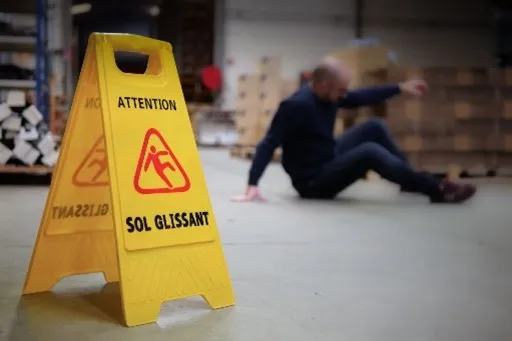
Did you know that over the last two years, falls occuring at same level (slips, trips, stumbles and other loss of balance on a flat surface) have been the 3rd main cause of accidents at CERN. These falls occur both inside and outside the premises. With a 12% share of all accidents recorded, this category of accidents accounts for 15% of all causes of absence from work.
On what aspects of work can we act collectively to limit these accidents on a daily basis?
Get organised: Plan your appointments, your work and your projects as good as possible in order not to create emergency situations where rushing can lead to a fall.
Make sure that your workspace lighting is appropriate and that noise limits are respected. A noisy environment increases stress and reduces attention at work. If in doubt, measurements can be taken, so don’t hesitate to contact the SY Safety Office !
Clear escape routes, passageways and your workspace. Avoid cluttered equipment and cables left on the floor, and organise your storage so that there is no risk of tripping. As far as cable management is concerned, there are a number of solutions, such as the use of cable channels, cable trays and covers.
The number of falls at same level is twice as high in winter as in summer (Source : CFST). In winter, you need to be extra vigilant, as surfaces can freeze over and uneven ground can be obscured by snow. Allow extra time for your journeys. Don’t forget to check the weather forecasts, which will give you valuable information, particularly in the event of frost.
In conclusion, the risk of a fall at same level can be the result of a number of factors: organisation of the work, the work space and the working environment, or even weather conditions. What these factors all have in common is that they are constantly changing: so stay vigilant and report any dangerous situation (EDH declaration)!
Also On At CERN
-

Six rules to avoid cycling accidents
To go further, follow the e-learning course: “Road traffic – Bike Riding“ Pour aller plus loin, suivez le cours e-learning “Circulation routière – Rouler à vélo“ Also On At CERN
-
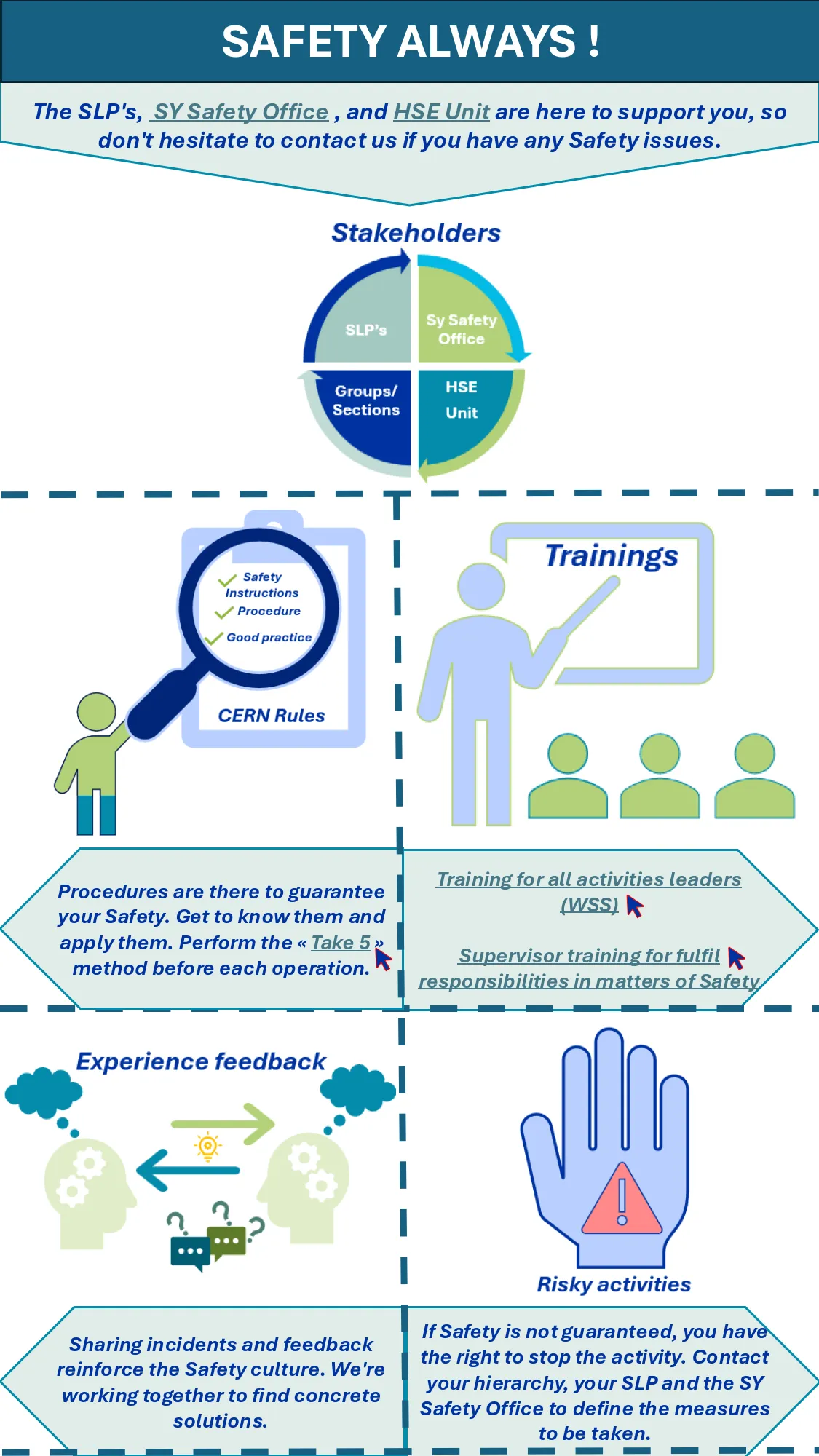
Safety always
Links: SY Safety Office HSE unit Method “Take 5“ Training for all activities leaders (WSS) Supervisor training for fulfil responsibilities in matters of Safety Also On At CERN
-
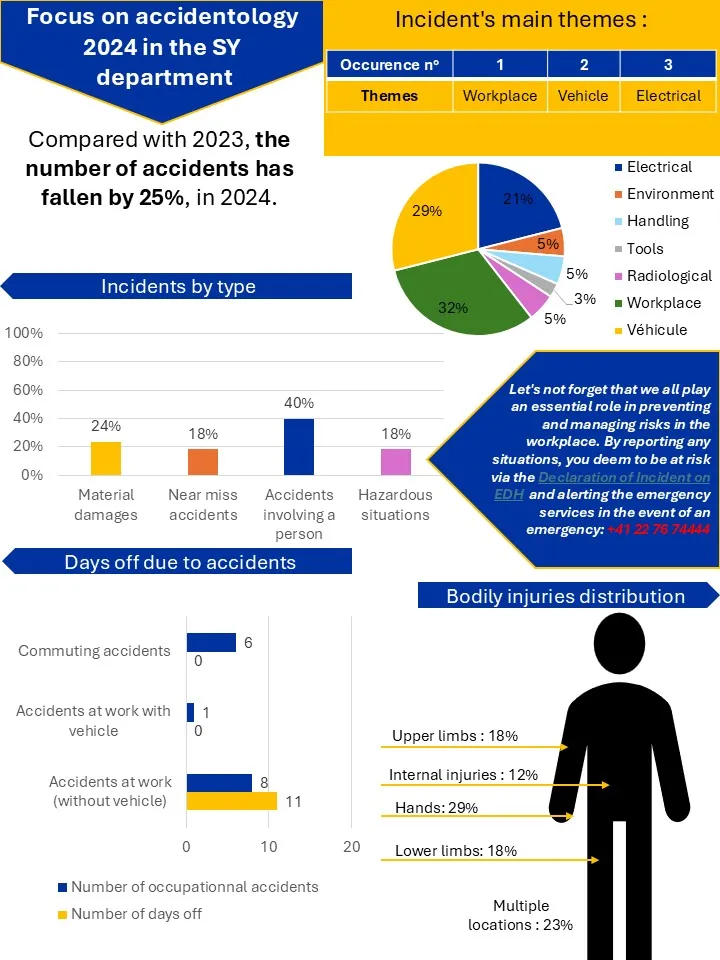
Focus on accidentology 2024 in the SY Department
EDH Incident declaration Also On At CERN
-
Incident declaration
All Safety Incidents occurring on the CERN site or related to CERN activities must be declared. This includes commuting accidents. The responsibilities in matters of safety incident management at CERN are specified in the Safety Regulation SR-SIM available on https://hse.cern/rules. The procedures related to the declaration of Safety Incidents are detailed in the admin e-guide.…
-
In an emergency, every second counts
Become an actor in case of medical emergency! Sign-up on the CERN’s Learning Hub for the “First Aid – Life Saving Actions (LSA) ” training. In this 3-hour course, you will learn who to deal with emergency situations: protect, alert and perform essential first aid actions. The French Federation of Cardiology estimates that each minute…
-

Radiological reminder – Visits nonprofessional and professional ionising radiation areas
For all types of visits on “supervised” areas and professional visits on “supervised” an “controlled” areas, according to General Safety Instruction GSI-SH-1 EDMS 1137263, the escort shall wear his passive dosimeter DIS and activate an Operational dosimeter DMC from the beginning of the visit, with dedicated IMPACT – Professional visit, which has first been validated…
-

What is your security behavior? Evaluate your safety culture
Do you apply the necessary measures for your safety and that of your loved ones (colleagues, family…)? Take this test to assess your safety culture and list your progress! Only one answer per question is possible. Write down your answers and you can determine your profile with the results at the end of the questionnaire!…
-
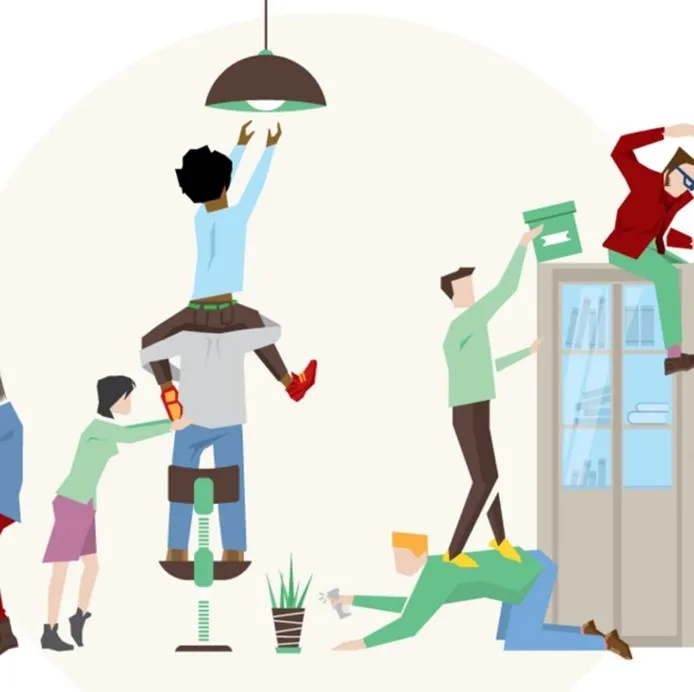
From tidying up the workspace to a healthy, risk-free working environment
Did you know that objects left on the floor are one of the main causes of accidents at home and at work? Although they may appear harmless, objects that are stored incorrectly or on pathways can be the cause of colisions, falls and slips that can have serious consequences for your health. Although these accidents…
-
Falls occuring at same level
Saviez-vous qu’au cours de ces deux dernières années, les chutes de plain-pied (glissades, trébuchements, faux-pas et autres pertes d’équilibre sur une surface plane) représentent la 3ème cause principale d’accidents au CERN. Ces chutes surviennent aussi bien à l’intérieur qu’à l’extérieur des locaux. Avec une part de 12% de l’ensemble des accidents répertoriés, cette catégorie d’accidents…
-
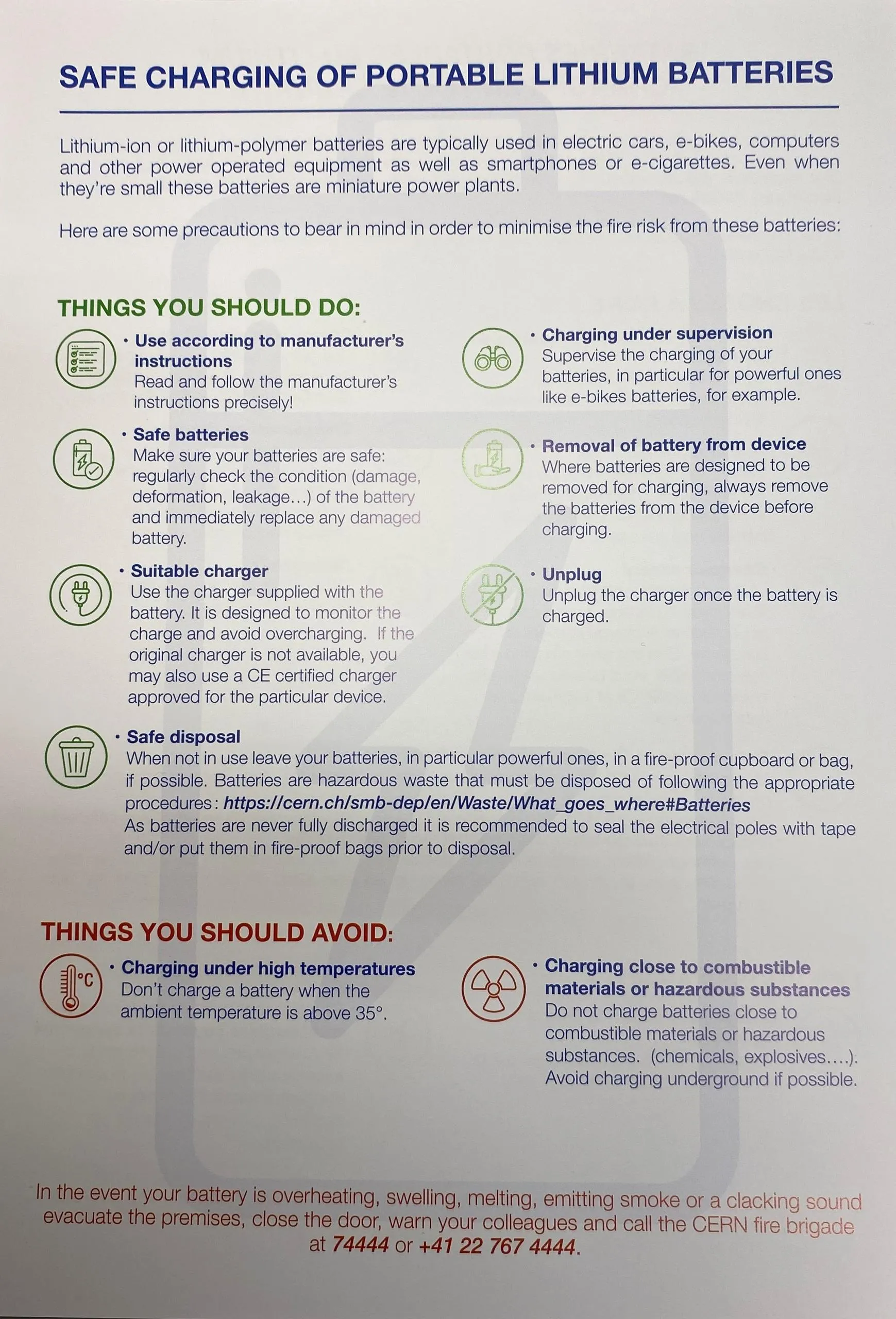
Safe charging of portable lithium batteries
LINK to the CERN bulletin article Also On At CERN